Ubuntu vs Fedora vs Debian vs Arch: Best Linux Distro for Developers (2026)

Choosing a Linux distribution used to be a weekend hobby debate. In 2026, it’s a genuine productivity decision. Fedora has quietly increased its developer share over three years, Debian remains the quiet workhorse of production servers, and Arch’s rolling-release model gives developers fast access to upstream package updates, while Ubuntu and Debian prioritize predictable security maintenance through supported release branches.
This guide compares Ubuntu, Fedora, Debian, and Arch Linux across six dimensions that actually matter for developers: adoption, package management, raw performance, release cadence, security response, and container support. We’ve drawn on the Stack Overflow Developer Survey 2025, Phoronix benchmarks, and CVE timeline data to give you concrete numbers, not gut feelings.
Key Takeaways
- In 2025, Ubuntu held 27.7% developer adoption — more than Fedora (3.7%), Debian (10.4%), and Arch (4.6%) combined (Stack Overflow Developer Survey 2025).
- Arch and Fedora usually receive newer upstream packages faster, while Ubuntu LTS and Debian Stable prioritize backports, mitigations, and predictable long-term maintenance.
- Debian Stable is the top choice for production servers requiring multi-year uptime predictability.
- All four distros support Docker Engine and Kubernetes tooling without major configuration hurdles.
Quick Comparison: Ubuntu vs Fedora vs Debian vs Arch (2026)
| Category | Ubuntu 26.04 LTS | Fedora 44 | Debian 13 Stable | Arch Linux |
|---|---|---|---|---|
| Best For | General-purpose development, cloud VMs, broad documentation | Fresh desktop stack, newer toolchains, GNOME/Wayland, Red Hat-adjacent workflows | Production servers, CI nodes, predictable base system | Full control, latest packages, power users |
| Release Model | Fixed LTS release; 5 years standard support, 10 years with Ubuntu Pro ESM | Fixed release, roughly 6-month cycle, about 13 months support | Fixed stable release; roughly 2-year major cycle, 5-year lifecycle | Rolling release |
| Package Manager | APT + Snap | DNF; rpm-ostree on Atomic variants | APT | pacman + AUR |
| Kernel Version | 7.0 GA generic stack | 6.19 at initial release; updated quickly during Fedora 44 lifecycle | 6.12 LTS | 7.0.x rolling; May 2026 ISO uses 7.0.3 |
| Developer Adoption* | 27.7% | 3.7% | 10.4% | 4.6% |
| Security Update Model | Security backports via Ubuntu Security Notices; optional Livepatch/ESM with Ubuntu Pro | Fast-moving package and kernel updates through Fedora repositories | Conservative security backports for Stable | Fast upstream package updates, but rolling-release maintenance risk |
| Learning Curve | Low | Low–Medium | Medium | High |
| Container Tooling | Docker and Podman available; Docker common in cloud/dev docs | Podman-first ecosystem; Docker also installable | Docker and Podman available; common server base | Docker or Podman manually installed/configured |
| Our Verdict | Best overall ecosystem | Best mainstream “fresh stack” workstation | Best server stability | Best for power users and latest packages |
Note: * Developer adoption is based on Stack Overflow Developer Survey 2025 “primary operating system in which you work” professional-use responses. It is not overall desktop market share, server market share, or total Linux install share.
Which Linux Distro Do Developers Actually Use in 2026?
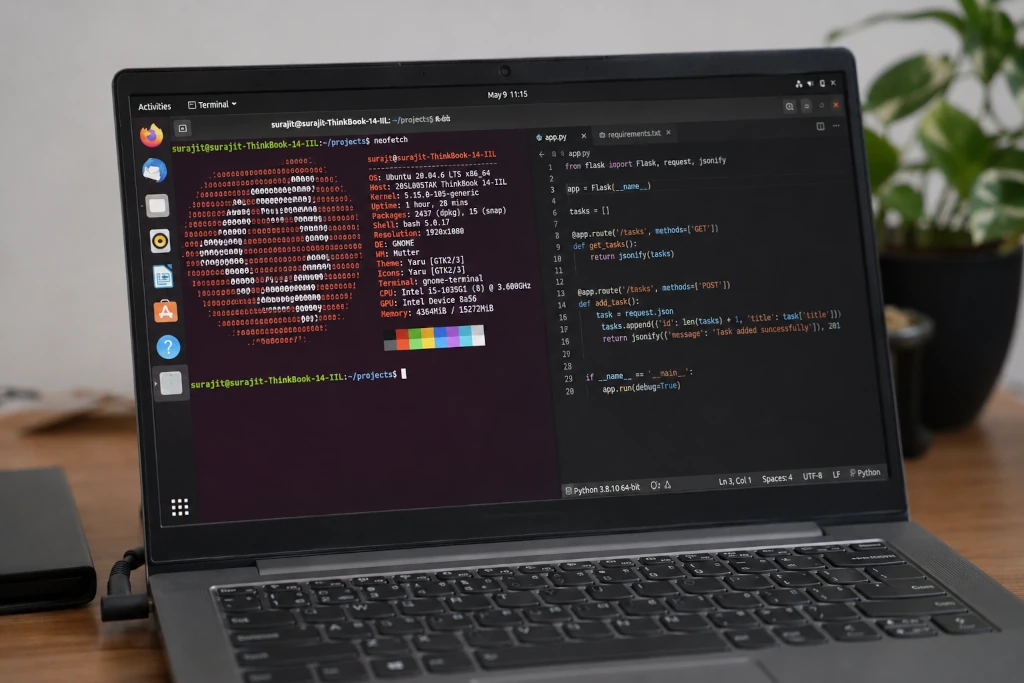
In 2025, the Stack Overflow Developer Survey revealed that Ubuntu held 27.7% developer adoption for professional use — more than Debian (10.4%), Fedora (3.7%), and Arch (4.6%) combined. Ubuntu’s dominance comes from a decade of being the default “just works” option in onboarding docs, Docker tutorials, and cloud VM images.
According to the Stack Overflow Developer Survey 2025, which surveyed over 49,000 developers across 177 countries, Ubuntu is used by 27.7% of professional developers as their Linux distribution of choice (Stack Overflow, Technology Report 2025).
Linux Distro Developer Adoption — Stack Overflow 2025 Linux Distro Developer Adoption (Stack Overflow 2025) 0% 10% 20% 30% 27.7% Ubuntu 10.4% Debian 4.6% Arch 3.7% Fedora Source: Stack Overflow Developer Survey 2025 — Professional use among Linux usersWhich Distro Has the Best Package Manager for Developers?
Package management is where distros diverge most sharply in day-to-day use. Ubuntu’s apt has the largest binary repository and widest third-party support — nearly every developer tool ships a .deb package first. But Canonical’s push to replace apt packages with Snap has become its biggest liability among experienced developers: Snaps are larger, mount as loop devices, and launch measurably slower than their apt equivalents.
Fedora’s dnf (Dandified YUM) offers superior dependency resolution and cleaner transaction rollbacks than apt. It doesn’t force a secondary packaging format on you. Fedora also supports rpm-ostree for immutable, image-based updates — a workflow increasingly popular in CI/CD pipelines where reproducible system state matters.
Arch’s pacman is the fastest package manager of the four by raw operation speed, and the AUR (Arch User Repository) contains over 80,000 packages — making it the deepest software ecosystem available to a Linux developer. The trade-off: AUR packages are community-maintained and carry no official security review. For a production server, that’s a red flag. For a developer workstation where you evaluate new tools constantly, it’s a superpower.
Debian’s apt is identical to Ubuntu’s at the package manager level, but the Debian Stable repository is intentionally conservative — packages are frozen at tested versions, not latest releases. That’s a feature on a production server and a frustration on a development workstation.
[Managing packages on a Linux VPS → tutorial on how to reinstall a package on debian]
Which Linux Distro Performs Best on Developer Hardware?

Performance depends heavily on the hardware, kernel version, graphics stack, compiler toolchain, filesystem, desktop environment, and background services. Because of that, there is no universal “fastest Linux distro” for every developer machine. Recent benchmarking does show that newer rolling or fast-moving distributions can perform very well out of the box, but the margin varies by workload.
In April 2026, Phoronix tested CachyOS, Ubuntu 26.04 LTS, Fedora Workstation 44, and Ubuntu 24.04.4 LTS on the same HP Z6 G5 A workstation with an AMD Ryzen Threadripper PRO 9975WX, 128 GB DDR5-5600 memory, an NVIDIA RTX PRO 6000 Blackwell Max-Q GPU, and a Samsung NVMe SSD. The test did not include Debian, Arch Linux directly, or openSUSE Tumbleweed. In that comparison, CachyOS led the overall geometric mean, while Ubuntu 26.04 LTS and Fedora 44 traded wins across individual workloads.
That makes Fedora 44 a strong performance-focused desktop choice, especially for developers who want newer GNOME, Wayland, compiler, and library stacks than a typical long-term-support distribution. The available Phoronix April 2026 comparison shows a more nuanced picture: CachyOS led overall, Ubuntu 26.04 LTS performed well in some Python workloads, and Fedora 44 was competitive in workloads such as PHP.
Boot-time numbers should also be treated carefully. A Fedora installation may boot faster than Ubuntu on a specific test machine, especially if Ubuntu has more default services or Snap-based applications enabled, but boot time is not a universal distro property. It changes with firmware, disk speed, encryption, GPU drivers, desktop environment, enabled services, and whether the installation is minimal or full desktop.
A safer conclusion is this: Fedora 44 is usually the better choice if you want a fresh mainstream desktop stack with newer developer tooling, while Ubuntu 26.04 LTS is the better default if you prioritize long-term support, documentation, commercial software compatibility, and cloud parity. Arch can be extremely fast on a minimal, well-maintained install, but results depend heavily on how the user configures the system. Debian Stable is not usually chosen for peak desktop benchmark performance; it is chosen for predictability, low churn, and long-running server stability.
How Do Release Cycles Affect Your Development Workflow?
The choice between fixed releases and rolling releases is fundamentally a risk trade-off. Ubuntu 26.04 LTS gives developers a predictable base with five years of standard security updates and critical bug fixes, with longer coverage available through Ubuntu Pro. That makes it a strong choice for development machines, cloud VMs, and servers where you want stability without constantly tracking upstream changes.
Fedora
Fedora moves faster. Its release cycle is roughly six months, with each release maintained for about 13 months. In practical terms, Fedora usually gives developers newer desktop components, kernels, compilers, language runtimes, and system libraries sooner than long-term-support distributions. Fedora 44, for example, includes a very fresh developer stack, including GCC 16.1, glibc 2.43, LLVM 22, Go 1.26, Ruby 4.0, and CMake 4.0. This makes Fedora attractive if you want a mainstream workstation distro with newer tooling but do not want a full rolling-release system.
Ubuntu
Ubuntu 26.04 LTS is also much fresher than older Ubuntu LTS releases. It ships GCC 15.2, Python 3.14, LLVM 21, Rust 1.93, Go 1.25, OpenJDK 25, and glibc 2.43. So the difference is not that Fedora always has every major developer tool six to twelve months ahead of Ubuntu. A better way to frame it is this: Ubuntu LTS prioritizes a stable, long-supported base, while Fedora accepts more frequent upgrades in exchange for faster access to newer desktop and development components.
Arch Linux
Arch Linux takes the rolling-release model further. Instead of upgrading from one major distribution release to another, you continuously upgrade the system with pacman. This gives developers access to very recent packages and makes Arch attractive for users who want full control over their environment. The trade-off is maintenance responsibility: Arch users should perform full system upgrades regularly, read relevant Arch news before major upgrades, and be prepared to handle occasional manual intervention when packages or configuration defaults change.
Debian
Debian Stable changes slowly by design. In 2026, the current Stable release is Debian 13 “trixie”. Debian 13 uses the Linux 6.12 kernel series on amd64 and follows Debian’s stable lifecycle: roughly three years of full support followed by two years of Long Term Support. For long-lived CI nodes, production servers, and infrastructure where predictable behavior matters more than the newest toolchain, Debian Stable remains one of the safest choices.
The practical takeaway is simple: choose Ubuntu LTS when you want broad documentation, cloud compatibility, and long-term support; choose Fedora when you want a fresher mainstream workstation stack; choose Arch when you want rolling updates and maximum control; and choose Debian Stable when you want low churn and long-running server predictability.
Which Distro Responds to Security Vulnerabilities Fastest?

Arch Linux
For the recent Copy Fail vulnerability (CVE-2026-31431), Arch Linux’s security tracker lists the issue as fixed in the linux package starting with version 6.19.12-1. That supports the general point that rolling distributions can receive upstream kernel fixes quickly. However, it is not enough to claim that Arch always patches critical CVEs in 1–3 days. Patch timing depends on the package, maintainers, upstream fix quality, regression risk, and whether the fix has landed in the kernel branch used by the distro.
Ubuntu
Ubuntu handled Copy Fail by publishing mitigation guidance and updated kmod packages to disable the affected kernel module while kernel updates were being prepared. This illustrates the Ubuntu LTS security model: rather than constantly moving to the newest upstream kernel, Ubuntu usually backports or mitigates security fixes for supported releases. That approach prioritizes stability, but it can make simple “days-to-patch” comparisons misleading unless you distinguish between mitigation availability, kernel package availability, and reboot requirements.
Fedora
Fedora usually tracks newer kernels and system components than long-term-support distributions, so it can receive some kernel fixes quickly through normal package updates. Debian Stable takes the more conservative path: it keeps a stable base and applies security fixes to supported packages instead of chasing the newest upstream versions. Debian’s standard release lifecycle is roughly three years of full support followed by two years of LTS, making it attractive for predictable server operations.
Ubuntu Pro
Ubuntu Pro changes the operational picture for Ubuntu servers. It adds Kernel Livepatch for many high and critical kernel vulnerabilities, allowing selected kernel security fixes to be applied without an immediate reboot, and it extends Ubuntu LTS security maintenance to 10 years. Ubuntu Pro is also free for personal use on up to five physical machines. For production Ubuntu servers where reboot windows are difficult, that can matter more than the raw speed of a normal package update.
The practical takeaway is this: Arch and Fedora are usually faster-moving because they track newer upstream packages and kernels. Ubuntu LTS and Debian Stable prioritize predictable security maintenance through backports, mitigations, and long support windows. For developer workstations, faster package movement can be useful. For production servers, the best choice is often the distro whose security process, reboot policy, and support lifecycle match your operational requirements.
Who Should Use Which Linux Distro?
There is no universal winner. The right Linux distribution depends on your role, risk tolerance, hardware, deployment target, and how much time you want to spend maintaining the operating system itself.
Solo developers and open-source contributors
Start with Ubuntu 26.04 LTS if you want the safest default. It has broad documentation, strong third-party software support, official cloud images, and a long-term-support lifecycle. Docker Engine is officially documented for Ubuntu 26.04 LTS, which makes Ubuntu a practical choice for developers who want their local environment to resemble common cloud and CI/CD setups. Fedora is the better next step if you want a fresher desktop stack and newer developer tooling while staying on a mainstream, release-based distribution.
Developers who live in the terminal and compile from source
Arch Linux is a strong fit if you want a minimal base system, rolling updates, and full control over what is installed. The Arch User Repository is one of Arch’s biggest advantages for developers because it often provides build scripts for software that is not packaged in official repositories. The trade-off is responsibility: AUR packages are community-maintained and unsupported, so you should review build files and understand what you are installing. Arch also has widely respected technical documentation, but it expects users to be comfortable reading docs and fixing occasional upgrade issues.
DevOps engineers and CI/CD pipeline operators
Debian Stable is the best fit for long-lived nodes where low churn and predictable behavior matter more than the newest package versions. In 2026, that means Debian 13 “trixie,” the current Stable release. Debian’s lifecycle provides roughly three years of full support followed by two years of Long Term Support. Ubuntu LTS is also a strong choice for cloud VMs, especially when official images, vendor documentation, Ubuntu Pro, or compatibility with common cloud tutorials matter.
Teams that work close to the Red Hat ecosystem
Fedora is useful for developer workstations, staging environments, and teams that want to track technologies that may later influence CentOS Stream and Red Hat Enterprise Linux. Fedora is upstream of RHEL, but it should not be described as an exact preview of RHEL on a fixed timeline. Treat it as a fast-moving community distribution where new Linux technologies are integrated earlier than in enterprise long-term-support releases.
Teams building containerized applications
All four distributions can run modern container tooling. Docker Engine is officially documented for Ubuntu and Fedora, while Podman is available across major Linux distributions. Fedora has especially strong Podman integration, and Podman is built in on Fedora CoreOS and Fedora Silverblue. Ubuntu remains very convenient for Docker-based tutorials and cloud workflows. Debian is excellent for stable container hosts. Arch works well for users who prefer manual setup and full control.
Developers who want an immutable or atomic desktop
Fedora Silverblue is worth considering. It uses an rpm-ostree-based atomic desktop model, where the base operating system is updated as an image-like system with rollback support. This can be attractive for developers who want a more reproducible workstation and prefer to keep applications and development environments separated from the base OS.
Frequently Asked Questions
Which Linux distro is best for developers in 2026?
Ubuntu 26.04 LTS is the best default for most developers. It has strong documentation, broad tool support, and a five-year LTS lifecycle. Stack Overflow’s 2025 survey also shows Ubuntu as the most used Linux distro among professional developers, at 27.7%.
Fedora is better if you want newer desktop and developer tooling. Arch is best if you want full control and rolling packages. Debian Stable is best for long-running servers and CI nodes.
Is Fedora better than Ubuntu for development in 2026?
Fedora is better if you want a fresher Linux desktop stack. It usually ships newer kernels, GNOME releases, compilers, and libraries than long-term-support distros.
Ubuntu is better if you want wider documentation, cloud parity, and long-term support. It is also easier to match with common tutorials, CI images, and VPS setups.
Is Arch Linux worth using as a daily driver for developers?
Yes, if you want a rolling-release system and full control. Arch gives you recent packages and a minimal base system. The Arch Wiki is also one of the most useful Linux documentation resources.
The AUR is a major advantage, but it comes with risk. AUR packages are community-maintained and unsupported. You should review what you install.
Arch is not the best choice if you want a system that needs little maintenance. It works best for users who are comfortable reading update notes and fixing occasional package changes.
Which Linux distro is most stable for a development server?
Debian Stable is the safest choice for low-churn servers. It changes slowly and focuses on predictable behavior. This makes it a strong fit for CI nodes, internal tools, and long-running services.
Ubuntu LTS is also a strong server choice. It has broad cloud support, official images, and optional Ubuntu Pro coverage. Choose Ubuntu when vendor support and cloud documentation matter more.
Can I use Docker and Kubernetes on all four distros?
Yes. Ubuntu, Fedora, Debian, and Arch can all run modern container tooling. Docker, Podman, kubectl, kubeadm, and k3s are available through official docs, distro packages, or manual install methods.
Ubuntu is the easiest match for Docker-heavy tutorials and cloud examples. Fedora has strong Podman and SELinux integration. Debian is excellent for stable container hosts. Arch works well if you prefer manual setup.
Final Verdict: Category Winners
| Category | Winner |
|---|---|
| Developer Adoption & Ecosystem | Ubuntu |
| Package Availability | Arch, thanks to the AUR |
| Fresh Mainstream Workstation | Fedora |
| Minimal Rolling System | Arch |
| Release Cycle Freshness | Arch |
| Server Stability | Debian |
| Long-Term Support | Ubuntu LTS |
| Lowest Learning Curve | Ubuntu |
| Container / DevOps Support | Ubuntu and Fedora |
| Best Overall for Most Developers | Ubuntu 26.04 LTS |
Conclusion
Most developers should start with Ubuntu 26.04 LTS. It has the largest developer share among the Linux distros in Stack Overflow’s 2025 survey. It also has strong documentation, broad tool support, and a predictable LTS lifecycle.
Fedora 44 is the better choice if you want newer desktop and developer components. It suits developers who want a modern workstation without moving to a full rolling-release distro.
Arch Linux is best for users who want control. It gives you recent packages, a minimal base, and access to the AUR. The trade-off is maintenance. You need to keep the system updated and read important upgrade notes.
Debian Stable is best for servers. It is not the flashiest option, but that is the point. It changes slowly, behaves predictably, and works well for long-running infrastructure.
The final choice depends on your workflow. Use Ubuntu for the safest default. Use Fedora for a fresher workstation. Use Arch for maximum control. Use Debian for stable servers.
Comments (0)
Sign in to join the discussion
Sign in