RTX 5090 GPUs and Missing ROPS

This report delves into the recent discovery that some NVIDIA GeForce RTX 5090 GPUs are shipping with fewer Raster Operation Units (ROPS) than specified, impacting their performance. The RTX 5090, launched in January 2025 as NVIDIA’s flagship GPU under the Blackwell architecture, boasts 32 GB of GDDR7 memory and 21,760 CUDA cores, positioning it as a powerhouse for gamers and creators. However, reports from early 2025 have uncovered a concerning issue: some units have 168 ROPS instead of the expected 176, leading to performance degradation. This analysis covers the technical details, affected models, performance impacts, and consumer guidance, ensuring a comprehensive understanding for enthusiasts and buyers.
Understanding ROPS in GPU Architecture
ROPS, or Raster Operation Units, are integral to a GPU’s rendering pipeline. They handle the final stages of rendering, including alpha blending (combining pixel colors with backgrounds), stencil testing (determining pixel visibility based on a stencil buffer), and depth testing (ensuring closer pixels are drawn). These operations are critical for high-resolution gaming and complex 3D rendering, where many pixels are processed simultaneously. A higher ROP count typically enhances a GPU’s ability to manage these tasks efficiently, reducing bottlenecks in graphically intensive applications.
The RTX 5090’s standard specification includes 176 ROPS, which aligns with its role as a top-tier GPU. However, the discovery of units with only 168 ROPS suggests a potential manufacturing or quality control issue, which could compromise performance in scenarios reliant on rasterization.
The Specific Issue with RTX 5090 GPUs
Reports from reputable sources, including TechPowerUp and VideoCardz.com, indicate that some RTX 5090 GPUs, particularly from Zotac and MSI, have fewer ROPS than advertised. The issue was first identified in a Zotac RTX 5090 Solid card reviewed by TechPowerUp, which underperformed compared to other models. They confirmed the card had 168 ROPS instead of 176 using GPU-Z, a utility for GPU specifications. This finding was corroborated by forum users and an X post from leaker @9550pro, showing an MSI RTX 5090D with the same reduced count, suggesting the problem extends beyond Zotac.
The discrepancy is significant, as ROPS are not configurable by add-in-card (AIC) partners like Zotac or MSI; NVIDIA sets them at the silicon level. This raises questions about quality assurance, with speculations ranging from defective GB202 chips to buggy BIOS settings. TechPowerUp noted that their review samples from ASUS, Gigabyte, Palit, and NVIDIA’s Founders Edition did not exhibit this issue. Still, the presence of affected MSI cards indicates potential batch-specific problems.
Performance Impact Analysis
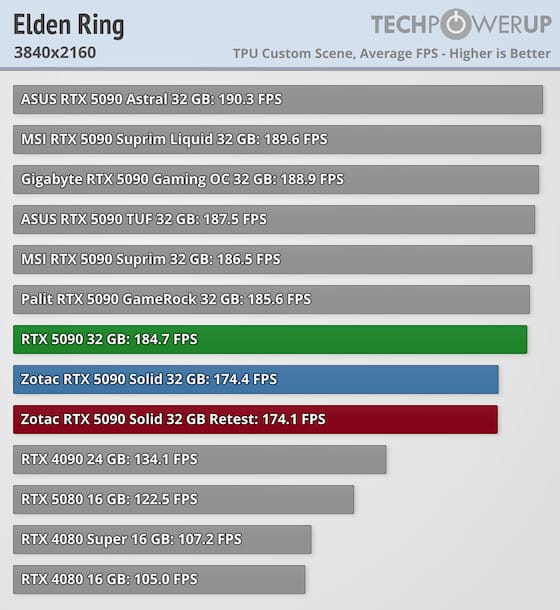
The reduction from 176 to 168 ROPS represents a 4.5% decrease in ROP count, but the performance impact can be more pronounced in specific workloads. ROPS are critical for rasterization-heavy tasks, such as anti-aliasing, depth testing, and color blending, which are active in most games. TechPowerUp’s re-testing revealed:
- 3DMark TimeSpy Benchmark: The affected Zotac RTX 5090 Solid scored 41,220, compared to around 46,300 for the standard RTX 5090, a performance difference of approximately 11%. This synthetic benchmark measures overall gaming performance, highlighting the ROP impact in standardized tests.
- Real-World Gaming Tests: In Elden Ring at 4K with maximum settings and no DLSS, the affected card averaged 75.6 fps, while the Founders Edition averaged 79.9 fps, a 5.6% performance drop. This real-world test underscores the impact in graphically demanding games without AI upscaling assistance.
The performance loss varies by application, with GPU-intensive games relying on rasterization showing more significant drops, while those leveraging ray tracing or DLSS might mitigate the effect. For content creators, tasks like 3D rendering or video editing could also see reduced efficiency, depending on the workload.
Affected Models and Scope
The issue has been confirmed in specific Zotac RTX 5090 Solid units and MSI RTX 5090D cards. Overclock3D reported the initial discovery with Zotac, while Tom’s Hardware noted the MSI RTX 5090D case, suggesting multiple vendors are affected. However, it’s not a universal issue; TechPowerUp’s other review samples from ASUS, Gigabyte, and Palit showed 176 ROPS, indicating the problem is likely batch-specific or related to specific manufacturing runs.
Speculation on X and Reddit (r/nvidia and r/pcgaming) suggests defective GB202 chips or hardware-level disabling of ROPS, potentially due to yield issues on the large 750mm² die. This could imply a limited recall or replacement program, but no official statement from NVIDIA or affected manufacturers has been issued as of early 2025.
Consumer Guidance and Next Steps
Given the potential performance impact, consumers with RTX 5090 GPUs should take proactive steps:
- Checking ROP Count: Use GPU-Z, a free tool available at its official website, to verify the ROP count. Launch the tool, select the “Graphics Card” tab, and look for the “ROP Units” field; it should read 176 for a standard RTX 5090.
- Action for Affected Units: If the count is 168, contact the manufacturer (e.g., Zotac, MSI) or retailer for possible remedies, such as replacement or refund. TechPowerUp is working with Zotac to return affected cards for investigation, as noted in their report.
- Purchasing Advice: For those considering buying an RTX 5090, ask sellers to verify the ROP count beforehand, especially for Zotac or MSI models. Opting for Founders Edition or cards from unaffected vendors like ASUS or Gigabyte might reduce risk.
- Staying Informed: Monitor official channels and tech news for updates, as manufacturers may release BIOS updates or initiate recalls. WCCFTech and HotHardware suggest the issue might be fixable via BIOS if software-related, but hardware defects could require replacements.
Pictures with affected cards
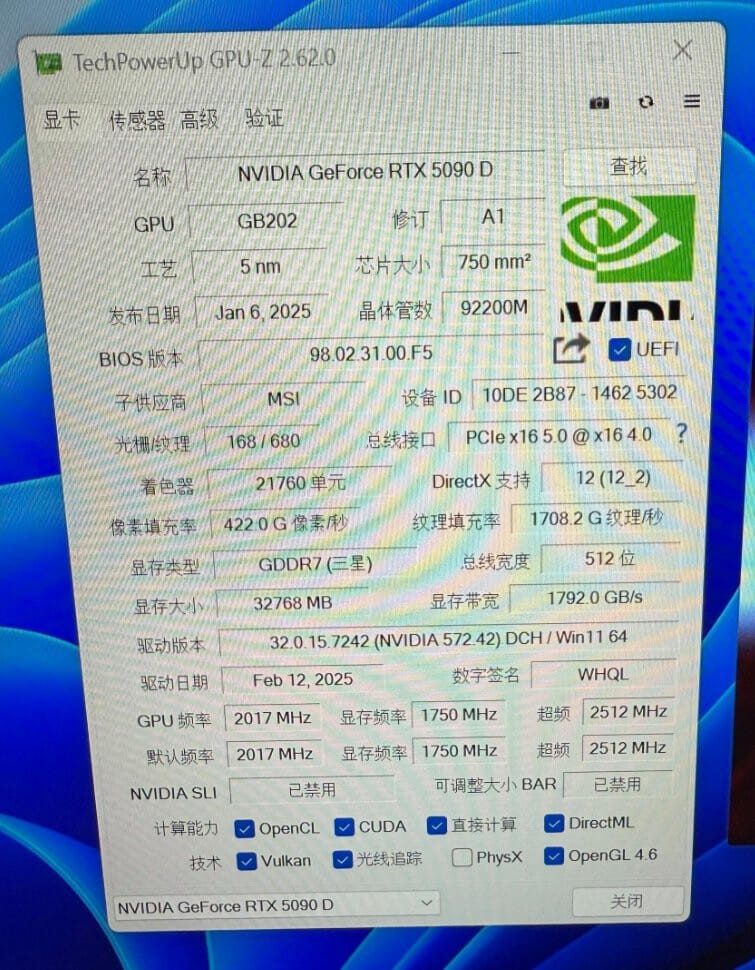 MSI RTX 5090D
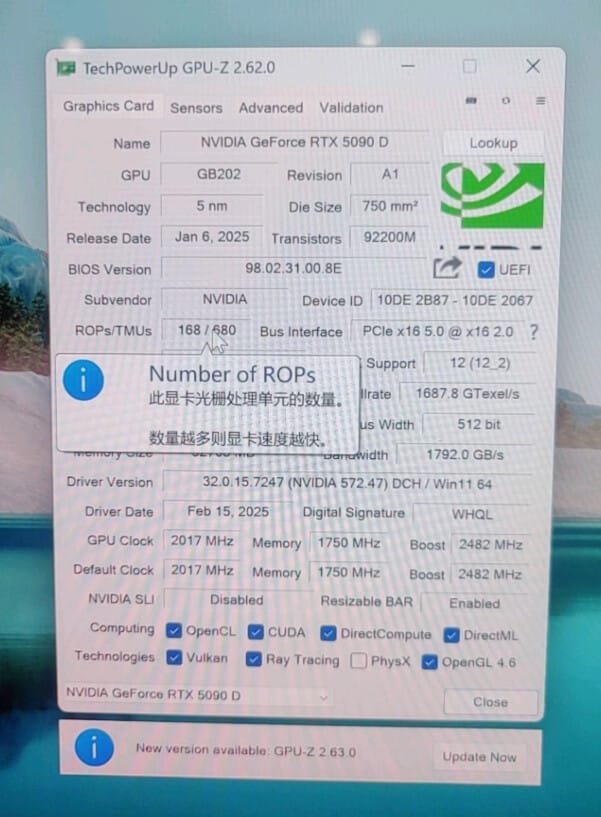 Secon MSI RTX 5090D
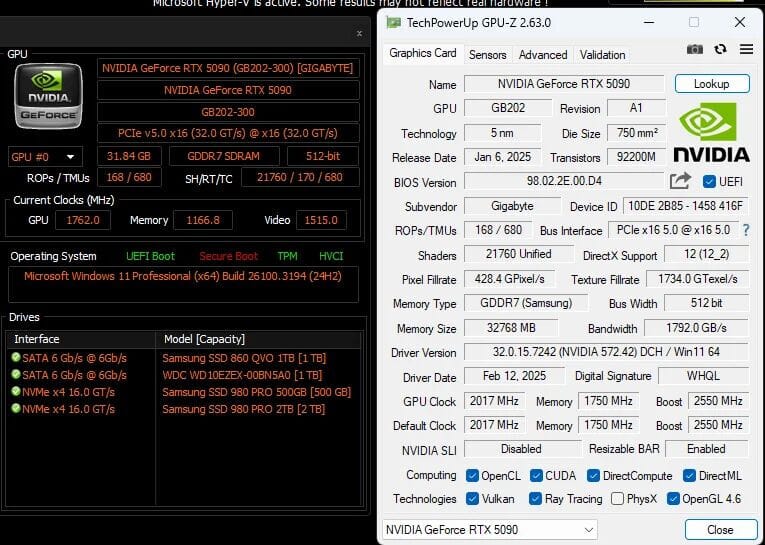 Gigabyte RTX 5090
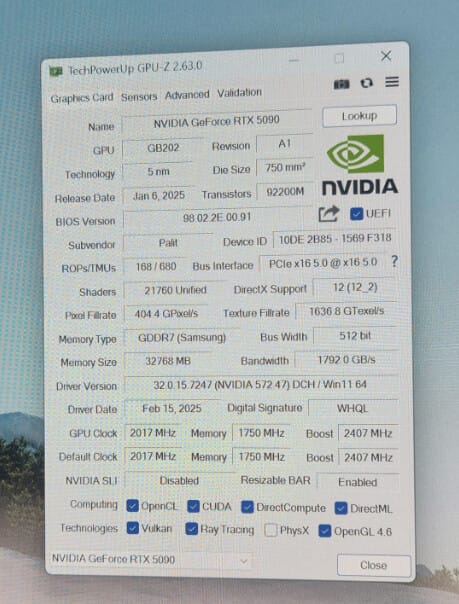 Palit RTX 5090
Conclusion and Future Outlook
The discovery of missing ROPS in some RTX 5090 GPUs underscores the challenges of high-end hardware production, particularly with complex dies like GB202. While the performance impact is measurable, it’s not uniform across all use cases, and not all cards are affected. Consumers should remain vigilant, leveraging tools like GPU-Z for verification and staying informed through official channels. As this story develops, further insights from NVIDIA and manufacturers will be crucial for resolving the issue and restoring confidence in this flagship GPU.
Update Feb 22nd:
NVIDIA’s global PR director, Ben Berraondo, confirmed this issue. He told The Verge:
We have identified a rare issue affecting less than 0.5% (half a percent) of GeForce RTX 5090 / 5090D and 5070 Ti GPUs which have one fewer ROP than specified. The average graphical performance impact is 4%, with no impact on AI and Compute workloads. Affected consumers can contact the board manufacturer for a replacement. The production anomaly has been corrected.
NVIDIA
Comments (0)
Sign in to join the discussion
Sign in